Small-P Politics: New article in British Journal of Sociology

I am happy to report that an article I have worked on with Emily Huddart Kennedy and John Parkins is now out in print in British Journal of Sociology.

 https://onlinelibrary.wiley.com/doi/epdf/10.1111/1468-4446.12614

The article is called “Small-p politics: how pleasurable, convivial and pragmatic political ideals influence engagement in eat-local initiatives”.

In the realm of local food, it’s often important to emphasize how food can be pleasurable and convivial. This is a pragmatic strategy for many reasons, and forces scholars to think carefully about what we mean by “politics”. Interviewing and observing food actors located in civil, state and market spheres in three Canadian cities, we describe a set of commonly articulated political ideals that inform and shape an engagement approach that we call “small-p politics”. We analyze why small-p politics is such an attractive option for food movement actors, but caution that narrowing the scope of tools and topics available for civic participation may compromise the ability for collective action to tackle barriers to justice and sustainability.

 

Congrats to Tyler Bateman, recipient of 2017 SSHRC PhD Fellowship

UxxDZn_D_400x400Warm congratulations to Tyler Bateman, a PhD student I supervise, for receiving a 2017 Social Sciences and Humanities Research Council of Canada Doctoral Fellowship. Tyler joins seven other students in the Department of Sociology at UofT who were awarded SSHRC fellowships this year.

Here is Tyler’s description of his exciting project, entitled Who cares about nature? The environmental sociology of perception.

With increasing urbanization, urban parks may play an important role in the ability of urban dwellers to develop an affective appreciation of wild organisms and their natural habitats. This research investigates the social processes that support and derive from the awe-inspiring discovery of animals, plants, and other organisms in urban parks. The thrill of discovering wild nature may be an important root of public discussions about conserving nature.

Anelyse Weiler co-authors article on migrant farm workers and food security

Anelyse Weiler. Photo Credit: Mike Benusic
Photo: Mike Benusic

Anelyse Weiler, one of the PhD candidates I’m supervising, is the lead author of a new article in International Migration: “Food Security at Whose Expense? A Critique of the Canadian Temporary Farm Labour Migration Regime and Proposals for Change.” Co-authored by Janet McLaughlin and Donald Cole , the article focuses on linkages between food security, food sovereignty, and Canada’s migrant farm worker regime. One of their core arguments is that pitting food security for Canadians against the rights of migrant farm workers is a false moral choice. They propose a range of policy options to advance dignity alongside migrant farm workers. These include granting migrant farm workers full immigration status on arrival, supporting worker-owned farms, and rethinking regulations that underpin concentrated corporate power in the food system.

Anelyse is currently conducting her dissertation fieldwork in BC and Washington state. Last year, the BC Canadian Centre for Policy Alternatives acknowledged her efforts to inform more just and sustainable food systems through the Power of Youth Leadership Award for Research, Analysis and Solutions.

Understanding the food preferences of people of low socioeconomic status

Although much is known about how affluent ‘‘foodies’’ use food as a marker of status and distinction, what are the food tastes of people with a lower socioeconomic status?

In a new article in the Journal of Consumer Culture, Shyon Baumann, Michelle Szabo and I investigate this question. We analyze interview data from 254 individuals from 105 families across Canada to explore the cultural repertoires that guide low-socioeconomic-status consumer tastes in food. We asked respondents across socioeconomic status groups which foods they prefer, and for what reasons.

We argue that low socioeconomic- status respondents show aesthetic preferences that operate according to four cultural repertoires. These repertoires are notably different from people with a high socioeconomic status who practice “cultural omnivorousness” (i.e. eating a wide range of high-status and low-status foods). Our respondents display tastes for foods from corporate brands, familiar ‘‘ethnic’’ foods, and foods they perceive as healthy.

Even though low-socioeconomic-status taste preferences in food are shaped by everyday economic constraints – what Bourdieu called ‘‘tastes of necessity’’ – we show how cultural repertoires guiding low-socioeconomic-status tastes relate to both material circumstances and broader socio-temporal contexts. Our findings shed light on the underlying meanings and justifications behind food ideals among people with low socioeconomic status.

Organic vs. local? New article in Canadian Food Studies

Photo of purple cauliflower. By Suzie's Farm on Flickr Creative Commons.
Photo by Suzie’s Farm: https://flic.kr/p/e9ouDX

Who buys organic food, and who prioritizes local food?

We provide some insights on this question in a new article published by Canadian Food Studies. The article, authored by Shyon Baumann, Athena Engmann, Emily Huddart-Kennedy and me, is based on a survey of food shoppers in Toronto. Here are a few of our key findings:

  • The intention to buy organic food tends to be associated with parents who have children under the age of five. Health and taste concerns are top of mind in informing their purchases.
  • The intention to buy local food tends to be associated with educated, white women consumers. For these shoppers, collectivist concerns like the environment and supporting the local economy are a key motivator.
  • We argue that the predominant ‘individualist’ vs. ‘collectivist’ framing in the scholarly literature should be reformulated to accommodate an intermediate motivation.
    • Organic food consumption is often motivated by a desire to consume for others (e.g. children) in ways that aren’t straightforwardly individualist or collectivist, but that instead exemplify a caring motivation that falls somewhere between the two.

Book reviews for Food and Femininity

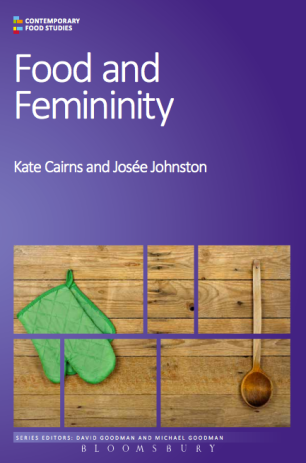
Cover of the book Food and Femininity by Kate Cairns and Josée Johnston.Professor Kate Cairns and I are always happy to hear when our recent book, Food and Femininity, has struck a chord with readers. Here is a compilation of the thoughtful reviews the book has received so far. We hope our contribution continues to push forward critical conversations about gender, feminism, food and inequality.

Conference season is underway

Photo of of a pile of lanyards.
Photo by Mack Male: https://flic.kr/p/p74G91

Academic conference season is underway! I’m looking forward to sharing my newest research at upcoming events, and several of the students I supervise will be speaking about their own exciting work. Here are some of the conferences where we will be presenting (or have recently presented):

Represent: Student Leadership Conference (29 – 30 April, Toronto)

  • Alexandra Rodney and Margaryta Ignatenko. “Disruptive Innovation Through Collaboration: Increasing Student Engagement” (28 April)

Indigenous Peoples’ Land Rights and the Roles of Ethnoecology & Ethnobotany (2- – 5 May, Victoria)

  • Anelyse Weiler. Wrap-up/Commentary with Barbara Wilson (3 May). Mediator for “Plants and Indigenous Environmental Stewardship Protected Areas: New Models for Indigenous Governance” (4 May)

Canadian Association for Food Studies (28-30, Toronto)

  • Josée Johnston. Panelist for “Communities, Collaboration, Complexity: Diverse Perspectives and Experiences of Canadian Food Studies” (28 May)
  • Alexandra Rodney. “Teaching Food Insecurity: The Social Assistance Food Budget Challenge” (30 May)

Canadian Sociological Association (29 May – 1 June, Toronto)

Canadian Association of College and University Student Services Annual Conference (11-14 June, Ottawa)

  • Kelly, Heather, David Newman, Julia Smeed, Jacquie Beaulieu and Alexandra Rodney. “(Re)Designing the student experience: What happens when we stop surveying students and start talking to them?” (14 June)

American Sociological Association (11 – 16 August, Montréal)

Alexandra Rodney receiving SAGE Teaching Innovations & Professional Development Award

Ali RodneyCongrats to Alexandra Rodney, who has been awarded a SAGE Teaching Innovations & Professional Development Award! The award is from the American Sociological Association Section on Teaching and Learning. As part of the award, she is heading to Montreal in August to take part in a pre-conference workshop on teaching and learning.

Alongside her dissertation research on healthy living blogs, which I supervise, Alexandra has been committed to strengthening student learning experiences both inside the classroom and with UofT’s Innovation Hub. This month, she’ll be presenting a paper at the Canadian Association of Food Studies assembly in Toronto on an experiential learning activity she designed to help students learn about the lived experience of food insecurity. Specifically, students in her Canadian Foodways class had the option of living on a social assistance food budget for one week (similar to BC’s Welfare Food Challenge). The assignment served as a powerful way of helping students connect their individual experiences with the broader context of inequality and food politics.


Can consumers buy alternative foods at a big box supermarket?

Supermarket
Photo credit: plasticchef1 on Flickr Creative Commons

A commentary I published in the Journal of Marketing Management, “Can consumers buy alternative foods at a big box supermarket?”, is now available online (and free for the month of May). It’s part of a special issue that considers the question of “alternatives” in food and drink markets (Eds. J Smith Maguire, J Lang and D Watson). I use a case study of ethical meat to consider the diverse, often contradictory ideals that inform consumers’ search for alternatives to mainstream market options.

I propose three main takeaways. 1) The goal of producing  consumer alternatives is significantly hampered by the competing, and often contradictory demands of market forces. 2) The discourse of food alternatives uses a ‘win-win’ logic suggesting that consumers don’t have to sacrifice anything or change their habits. I believe that consumer projects for ecological and social change face a necessary but exceptionally challenging task of reshaping, and even downgrading consumer expectations. 3) Although I’m deeply sympathetic to the desire to “feel good” about shopping, the search for eco-social alternatives cannot simply make consumers feel good about their purchases. Food ‘alternatives’ have to go beyond feel good feelings, and address the material realities and limitations of niche markets.

Food and femininity in the Sociological Review

Food and Femininity Cover

Dr. Rebecca Sandover, an Associate Research Fellow in Geography at the University of Exeter, recently took the time to write a very thoughtful review of Food and Femininity. You can read the full piece in the Sociological Review, and here is an excerpt:

Through an immersion in the processes of decision making for household food choices, Food and Femininity offers a rich account of the thorny tensions faced by shoppers attempting to work out food ethics in their everyday eating lives. However, as Cairns and Johnston spotlight, these tensions are even more acute for women attempting to walk the tightrope of enacting feminist, post-feminist and healthy eating bodies within the framework of gendered food practices. . . . this book not only examines food and femininity, it also sets out feminist methodologies for researching food issues.