I am a Professor of Sociology at the University of Toronto. My major substantive interest is the sociological study of food. I see food as a lens for investigating questions that lie at the intersection of multiple areas like culture, politics, gender and the environment. Much of my work examines discourses of ethical consumption, and investigates how consumers seek social transformation within the constraints of contemporary market forces. I am also deeply interested in the topic of foodies – what they value, how they eat, and why the hamburger remains such an iconic food. My latest research project focuses on the cultural politics of meat consumption.
Research and teaching areas: sociology of food, cultural sociology, consumer culture, gender, environmental sociology and political ecology, and critical theory.

photo credit: Polina Teif
Selected publications
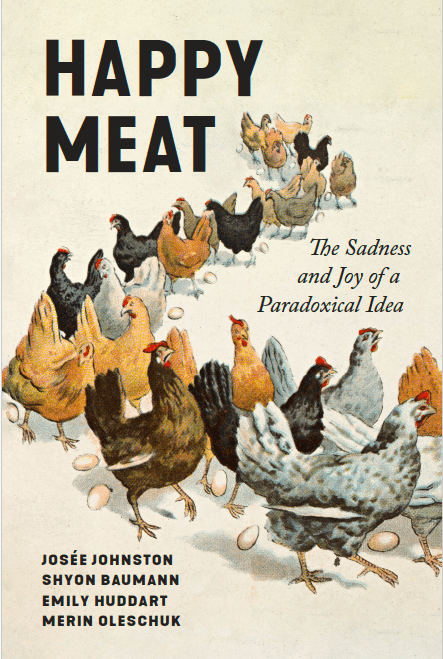
Happy Meat: The Sadness and Joy of a Paradoxical Idea
Josée Johnston, Shyon Baumann, Emily Huddart, Merin Oleschuk. 2025. Stanford University Press.
North Americans love eating meat. Despite the increased awareness of the meat industry’s harms – violence against animals, health problems, and associations with environmental degradation – the rate of meat eating hasn’t changed significantly in recent years. Instead what has emerged is an uncomfortable paradox; a need to square one’s values with the behaviors that contradict those values. The discourse of happy meat ultimately may not be a sufficient response to the critiques of meat-eating, rife, as it is, with internal contradictions. However, we make the case for its cultural and theoretical importance, as it exemplifies the significance of social context and emotions for understanding eating practices.

“Meat politics at the dinner table: Understanding differences and similarities in Canadians’ meat-related attitudes, preferences, and practices.“
Emily Huddart, Shyon Baumann, and Josée Johnston. 2024. Canadian Food Studies.
In this paper, we draw on survey data collected on a quota sample of Canadians in order to address the following questions: to what extent do Canadians across the political spectrum agree that meat is a problem?
“Moral and Aesthetic Consecration and Higher Status Consumers’ Tastes: The ‘Good’ Food Revolution.”
Baumann, Shyon, Emily Huddart Kennedy, and Josée Johnston. 2022. Poetics.
In this article, we use survey and focus group data to explore consumers’ orientations towards meat consumption. We identify and describe four key outlooks – pragmatism, aestheticism, moralism, and moral aestheticism – and find that individuals with higher social status are most likely to hold a moral aestheticism orientation.
 Josée Johnston